Updated November 7, 2026
Seoul is a large city, but getting around is surprisingly manageable once you understand its public transportation system. An extensive subway network, color-coded buses, rechargeable transportation cards, and real-time navigation apps make it possible to explore the city without renting a car.
For first-time visitors, however, a few questions can be confusing. Should you buy a T-money card? Can you use an international credit card? How do subway transfers work? And what happens if you forget to tap your card when leaving a bus?
This beginner-friendly guide explains how to use public transportation in Seoul, including the subway, city buses, fares, transportation cards, transfers, and common mistakes to avoid.
Whether you're visiting Korea for a weekend or staying for several weeks, understanding these basics can make your trip considerably easier.
1. Seoul Public Transportation at a Glance
Seoul's public transportation system includes subway trains, city buses, airport transportation, taxis, and other specialized services.
For most visitors, the subway and city buses will cover the majority of everyday journeys.
TransportationBest forHow to pay
| Subway | Traveling between major neighborhoods | T-money, supported transit passes, single-journey ticket |
| City bus | Reaching places away from subway stations | Transportation card or other accepted payment methods |
| Airport railroad | Traveling between Incheon Airport and Seoul | Appropriate railroad ticket or supported transit card |
| Taxi | Traveling with luggage or to less accessible destinations | Cash, supported payment cards, or taxi apps |
| City tour bus | Sightseeing along designated routes | Separate tour ticket |
The subway is usually the easiest place to start. Stations have numbered exits, route maps, and signs that commonly include English.
Buses are useful when the nearest subway station is a significant walk from your destination.
For a sightseeing experience rather than an ordinary commute, you can also explore our Yellow Balloon City Tour Bus guide. Remember that sightseeing buses generally require separate tickets and are not interchangeable with regular city buses.
2. Seoul Subway Basics
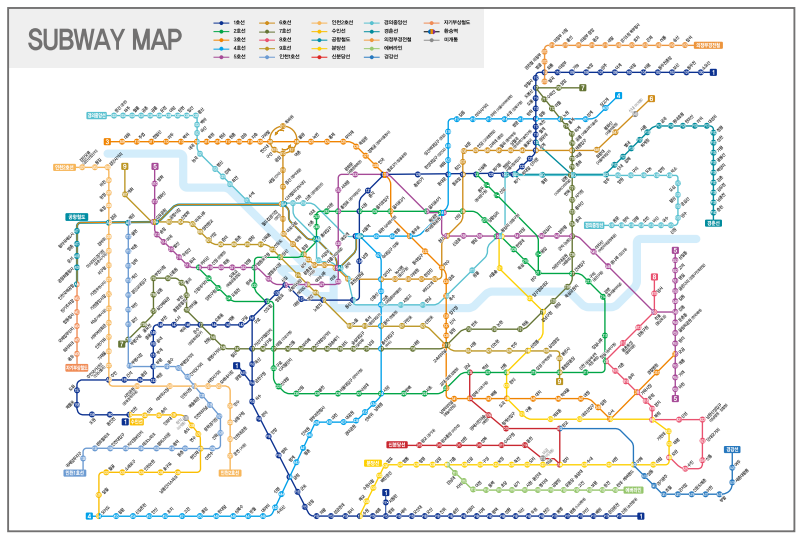
Understanding the Subway Map
Seoul's subway system uses numbered and named lines, each identified by a color.
For example:
- Line 1: Dark blue
- Line 2: Green
- Line 3: Orange
- Line 4: Light blue
- Line 5: Purple
Some other services, such as the Airport Railroad and the Sinbundang Line, use distinct names and fare structures.
A subway journey may involve one line or several transfers.
To plan your route, you need to know your destination station, the line serving that station, and the direction in which the train is traveling.
Platforms usually display a direction using the name of the next station or a terminal station. In some stations, different directions have separate entrances after the ticket gates.
Before going through a gate, check that you are entering the correct side.
How to Ride the Subway
Follow these steps for your first journey:
Step 1: Find the entrance
Look for the subway symbol and the station name. Entrances are numbered, and many stations have several exits spread across different streets.
Step 2: Plan your journey
Use a navigation app or station map to identify the line, direction, transfer stations, and destination exit.
Step 3: Enter through the ticket gate
Place your transportation card on the reader until it registers. If you have a single-journey ticket, tap that ticket instead.
Step 4: Follow the platform signs
Check the train's direction and the station names displayed on the platform.
Step 5: Transfer if necessary
At an interchange station, follow signs marked "Transfer" along with the relevant line number and color.
Many subway-to-subway transfers take place inside the paid area, so you do not need to leave the ticket gates.
Step 6: Exit at your destination
Tap your card at the exit gate. Follow the numbered exit recommended by your navigation app.
This last step is important. Some subway stations are extensive underground complexes, and choosing the wrong exit can mean a long walk.
3. Seoul Subway Fares in 2026
Seoul's published adult subway base fares are:
Ticket typeAdult base fare
| Transportation card | KRW 1,550 |
| Single-journey ticket | KRW 1,650 |
These are the published standard base fares for an adult traveling within the initial distance band. Longer trips and certain railway services may cost more.
The fare schedule above reflects the increase effective June 28, 2025, and remains the basis of Seoul's official subway fare guidance reviewed in November 2026.
Single-journey subway tickets require an additional refundable KRW 500 deposit.
For example, buying a standard adult single-journey ticket for a short trip may require KRW 2,150 upfront: the KRW 1,650 fare plus the KRW 500 deposit.
After completing your ride, return the ticket to the deposit refund machine to recover KRW 500.
A rechargeable transportation card avoids the need to buy and return a separate ticket for each journey.
4. What Is a T-money Card?
T-money is one of South Korea's most widely used rechargeable transportation cards.
It can be used on many subway lines, city buses, and supported taxis. The balance is deducted when you use the card.
For travelers moving between several neighborhoods, it is often more convenient than purchasing individual subway tickets.
Where to Buy a T-money Card
You can generally find T-money cards at convenience stores such as CU, GS25, and 7-Eleven, as well as at selected transportation-related sales locations.
Look for the T-money logo or ask a store employee:
"T-money card isseoyo?" (티머니 카드 있어요?)
This means, "Do you have a T-money card?"
The physical card normally has a separate purchase price, and you must add transportation credit before traveling.
How to Recharge Your Card
T-money cards can be recharged at participating convenience stores and supported station machines.
Payment methods vary by card type and charging location.
For an uncomplicated first trip, carrying some Korean won in cash is a useful backup, particularly when recharging a standard prepaid T-money card.
Do not assume that every station machine or convenience store will accept an overseas credit card for every type of transportation card.
Can You Use a Foreign Credit Card?
This is an important distinction.
Since March 17, 2026, Seoul has allowed internationally issued payment cards, including supported Visa and Mastercard cards, at new ticket vending machines installed across 273 subway stations on Lines 1–8.
These machines support purchasing single-journey tickets and purchasing or recharging eligible short-term Climate Card products.
However, being able to pay at a vending machine with a foreign card does not mean you can tap that same bank card directly at an ordinary subway gate or city bus reader.
The payment function at the ticket machine and the transportation fare system are separate.
Seoul also announced an average additional service fee of approximately 3.7% for applicable international-card transactions at these machines.
For visitors, the safest approach is to choose a supported transportation card or ticket before heading through the gates.
5. T-money or Climate Card?
Another option is Seoul's Climate Card Short-Term Pass.
Unlike T-money, which deducts a fare for each journey, the short-term Climate Card provides unlimited eligible rides during its validity period.
As of November 2026, Seoul's published short-term pass prices are:
PassPrice
| 1 day | KRW 5,000 |
| 2 days | KRW 8,000 |
| 3 days | KRW 10,000 |
| 5 days | KRW 15,000 |
| 7 days | KRW 20,000 |
For a physical Climate Card, the KRW 3,000 card purchase price is separate.
The validity period begins on the date the short-term pass is charged. It is not simply a rolling 24-hour period beginning with your first ride.
Which Card Should You Choose?
Choose T-money if you expect to travel outside Seoul, use transportation irregularly, or take a mix of eligible regional services.
Consider a Climate Card Short-Term Pass if you are staying mainly inside Seoul and expect to take multiple subway or city bus rides each day.
For example, a traveler using public transportation four times in one day might find a one-day pass attractive compared with buying four separate base-fare rides.
However, transfers can reduce the cost of ordinary card travel, so four boardings do not always mean four full fares.
The correct comparison depends on your itinerary, route distances, and transfer pattern.
Important Climate Card Limitations
The short-term Climate Card does not cover every train and bus in the Seoul metropolitan area.
Important exclusions include the Sinbundang Line, GTX services, airport and express buses, and many subway stations outside the eligible area.
Under the rules effective October 1, 2026, there is a special exception allowing passengers to exit at Incheon International Airport Terminal 1 or Terminal 2 after boarding within the eligible network.
That exception does not mean you can board at Incheon Airport using the Climate Card.
Always check the eligible route before choosing the pass.
For official coverage information, visit the Seoul Metropolitan Government's Climate Card guide.
6. How to Use Seoul City Buses
Seoul's bus network complements the subway system.
It can take you closer to traditional markets, residential neighborhoods, parks, and attractions that do not have a station immediately nearby.
Understanding Bus Colors
Different colors generally indicate different types of routes.
Bus colorMain function
| Blue | Major routes connecting important parts of the city |
| Green | Local and connecting routes, often linking with subway stations |
| Red | Metropolitan or express-type connections |
| Yellow | Circulation routes in designated areas |
These categories are useful for understanding the network, but you should choose a bus by its route number and destination rather than by color alone.
Step-by-Step Bus Guide
1. Find your bus stop.
Use Naver Map or Kakao Map to identify the correct bus number and stop location.
Check the direction carefully, because the stop for the opposite direction may be across the street.
2. Check the arrival information.
Electronic displays at many bus stops show estimated arrival times. Navigation apps also provide real-time bus information.
3. Board through the front door.
On ordinary city buses, passengers usually board at the front.
4. Tap your transportation card.
Place your card on the reader near the driver until the transaction is registered.
5. Watch for your stop.
Pay attention to announcements and your navigation app. Some announcements include English, but it is useful to follow the route on your phone.
6. Press the stop button.
Press the bell before your destination stop so the driver knows you intend to get off.
7. Tap your card before exiting.
Use the reader near the rear door, then leave through the rear exit.
Tapping when leaving is particularly important if you plan to transfer to another bus or the subway.
Avoid standing too close to the doors, and give passengers room to exit before moving through the bus.
7. How Transfers Work
One advantage of Seoul's transportation system is its integrated transfer discount.
When using an eligible transportation card, traveling from one service to another does not always require paying a completely new base fare.
For standard eligible transfers, the next boarding generally needs to occur within 30 minutes of the previous ride's exit tap.
The time allowance extends to 60 minutes during the nighttime period from 9 p.m. to 7 a.m.
The system allows up to four eligible transfers, meaning a journey can involve up to five boardings.
Additional charges may still apply depending on distance traveled and the types of transportation involved.
A Simple Transfer Example
Imagine you take the subway to a station near your destination but still need a short bus ride.
Instead of paying an entirely separate fare for the bus, an eligible transfer discount may apply when you use the same transportation card and complete the transfer within the time limit.
To preserve the applicable transfer benefit:
- Use the same transportation card throughout the journey.
- Tap when entering and leaving.
- Complete the transfer within the allowed time.
- Check whether your next service is eligible.
Boarding the same numbered bus route again is generally not treated as an eligible discounted transfer.
Also, avoid assuming that every airport bus, regional bus, or premium rail service participates in the same fare system.
8. Which Navigation App Should You Use?
For visitors who do not read Korean fluently, route-planning apps are extremely helpful.
Naver Map
Naver Map provides public transportation routes, station information, walking directions, and bus arrival information.
It is useful for finding nearby subway entrances and planning journeys that combine walking with buses or trains.
Kakao Map
Kakao Map is another widely used Korean mapping service.
It provides public transportation suggestions, bus stop information, and route alternatives.
It can be helpful to compare routes between the two apps when a destination has several possible entrances or transportation options.
Seoul Subway
The official Seoul Subway app is designed to help passengers navigate the subway network, including train routes, station facilities, and exit information.
For a first-time visitor, having one map app and a subway-focused backup can be sufficient.
Before leaving your hotel, save the Korean name of your destination as well as its English name. Korean-language place names can make searching or asking for assistance easier.
9. Practical Seoul Travel Examples
Visiting Myeongdong
Myeongdong is a popular shopping and dining district.
One straightforward way to reach the area is by using Subway Line 4 and exiting at Myeongdong Station.
Another option, depending on your starting point, is to approach from Euljiro 1-ga Station on Line 2.
After arriving, you can explore shops, Korean skincare stores, cafes, and street food areas on foot.
Our Myeongdong travel guide explains what you can see and do after getting there.
Visiting Gwangjang Market
Gwangjang Market is known for Korean street food, textiles, and traditional market culture.
Jongno 5-ga Station on Line 1 is one convenient subway access point.
After leaving the station, follow your navigation app to the market entrance you want to use.
Different entrances may lead toward different shopping and dining areas.
You can plan your visit using our Gwangjang Market food and shopping guide.
Exploring Several Attractions in One Day
Suppose your itinerary includes a traditional market in the morning, a shopping district in the afternoon, and a cultural attraction in the evening.
Before choosing a transportation pass, group nearby destinations together.
This reduces unnecessary transfers and allows more time for sightseeing.
If your plans involve many rides within the eligible Seoul network, compare the cost of ordinary T-money fares with the appropriate Climate Card Short-Term Pass.
If you plan to travel into surrounding areas, check whether your route requires a ticket that the pass does not cover.
10. Common Mistakes to Avoid
Even experienced travelers can make small transportation mistakes in an unfamiliar city.
Mistake 1: Forgetting to tap off a bus
This can interfere with transfer discounts or lead to an additional charge under the fare rules.
Mistake 2: Entering the wrong subway direction
Check the next-station or terminal-station sign before entering.
Mistake 3: Assuming a foreign credit card works at every gate
International cards may